Seasonal vs Nightly RV Camping: A Real 12-Month Cost Comparison
Two fictional but realistic families. Same RV, same goal of 20 weekends camping per year. One does it nightly, one does it seasonal. Here's what each actually pays — month by month.

Owner, Pine Ridge Campground
Army veteran and entrepreneur who co-founded Pine Ridge Campground in 2017. With years of hands-on experience in seasonal RV camping and campground operations, Jamie shares practical insights for campers exploring Pennsylvania.
Most "seasonal vs nightly" cost articles online are missing the same three things: actual fuel costs, dump-station fees, and the use-rate multiplier. Without those, the comparison looks like a wash. With them, the math tells a different story.
I wanted to write the version that includes everything. So I built out two hypothetical families — same RV, same vacation goals, same starting point — and tracked what each one actually pays across a full season. Below is what I came up with.
The setup
Both families have: - A 28-foot travel trailer (mid-size, common spec) - A half-ton truck towing it - A goal of camping 20 weekends per year (close to the national average for active RVers) - Home base in south-central Pennsylvania
Family A: Nightly camper. They book different campgrounds each weekend, mostly within a 2-3 hour drive, all in the $60-$80/night range for full-hookup sites.
Family B: Seasonal camper. They lease a $3,800/year site at a small family-owned campground (call it Pine Ridge if you want, but the math works for any operation in this price range). Their truck still gets used; the trailer doesn't move.
Both families take the same 20 weekends. Same kids. Same dog. Same firewood budget.
Family A's year (nightly camping, 20 weekend trips)
Let's add it up category by category.
Site fees
20 trips × 2 nights × $70/night avg = $2,800Reservation and booking fees
Most online booking platforms charge $5-$10 per reservation. 20 trips × $7 avg = $140Fuel for the truck (towing)
A half-ton truck towing a 28-foot trailer averages about 9-10 MPG. Average round-trip distance to a campground in the south-central PA area: ~120 miles. So 20 trips × 120 miles ÷ 10 MPG × $3.65/gal (current PA average) = $876Tolls
PA Turnpike runs through a lot of the available campground destinations. Realistic toll cost averaging across 20 trips: $180Dump-station fees at non-residence
Some campgrounds include dump in the nightly fee, some charge $10-$20 extra at checkout. Conservative average: $5 per trip × 20 = $100Propane refills
More frequent travel means more frequent setup/breakdown, more water heater cycling, and (depending on weather) more furnace use. Active nightly campers report 3-5 extra refills per year vs. seasonal. 4 refills × $35 = $140Eating-out premium
This is the sneaky one. When you're packing for a different campground every weekend, you eat out more — usually at least one extra restaurant meal per trip you wouldn't otherwise have. 20 trips × $45 family-of-four restaurant meal = $900Wear-related expense (annual amortized)
Frequent leveling, slide cycling, hitch wear, and tire stress add up. The average estimate from owner forums is $300-$500/year in incremental maintenance cost vs. a stationary trailer. Use the midpoint: $400Family A total: about $5,536/year
That's the real number for 20 weekends of nightly camping. The number most people think they're paying is just the $2,800 in site fees — about half of the actual total.
Family B's year (seasonal site)
Now the seasonal side. Same 20 weekends used.
Site lease
$3,800/year (flat, paid up front or in installments depending on the campground)Electric (metered)
Average $90/month across the 6-month season = $540Reservation fees
$0 (you have a permanent site)Fuel for the truck (no trailer in tow)
The truck still drives to the campground but it's not pulling 5,500 lbs anymore. Same 120-mile round-trip × 20 weekends ÷ 17 MPG (truck unloaded) × $3.65/gal = $515Tolls
Same as Family A: $180Dump-station fees
$0 (you have full sewer hookup)Propane refills
Trailer doesn't move, water heater cycling is more efficient, furnace use is similar. Maybe 2 refills/year vs. 4. Savings = $70 reduction. Use $70 for the 2 refills.Eating-out premium
Seasonals eat out less because the kitchen is fully stocked and the campsite is "home." Conservative reduction: 10 trips × $45 instead of 20 × $45 = $450Wear-related expense
The trailer isn't moving. Annual amortized incremental wear: roughly $100 (storage-related, primarily).Family B total: about $5,655/year
The first surprise: at 20 weekends, the costs are nearly identical
Notice what just happened. At 20 weekends used, the two families spend within $120 of each other for the year. Seasonal isn't dramatically cheaper at this use rate. It's roughly even.
That's the honest answer to "is seasonal cheaper than nightly?" — at 20 weekends, no, not really.
The second surprise: the use-rate multiplier
Here's where it gets interesting. The Family B (seasonal) cost is roughly flat whether they use 20 weekends or 26 weekends — because the site lease, electric base, and core costs don't scale with weekend count.
The Family A (nightly) cost scales nearly linearly. Every additional weekend trip adds roughly $250-$280 in site fees, fuel, tolls, and incidentals.
So here's what happens at different use rates:
| Weekends used | Family A (nightly) | Family B (seasonal) | Difference | |---|---|---|---| | 12 | ~$3,500 | ~$5,400 | Nightly is $1,900 cheaper | | 16 | ~$4,500 | ~$5,500 | Nightly is $1,000 cheaper | | 20 | ~$5,500 | ~$5,650 | About even | | 24 | ~$6,500 | ~$5,800 | Seasonal is $700 cheaper | | 28 | ~$7,500 | ~$5,900 | Seasonal is $1,600 cheaper | | 32 | ~$8,500 | ~$6,000 | Seasonal is $2,500 cheaper |
The break-even is right around 20-22 weekends per year.
Below that, you're paying for capacity you're not using. Above that, seasonal pulls ahead and the gap widens fast.
The third surprise: time
The cost math doesn't include the value of your time, but a lot of people would argue it should.
Setup and teardown on a trailer averages 2.5-3 hours per trip total (1.5 hrs in, 1 hr out). Across 20 weekend trips, that's 50-60 hours per year of labor that disappears with a seasonal site. If you value your time at even $25/hour, that's $1,250-$1,500 of unpriced cost in the nightly column.
I'm not going to put a dollar sign on it in the table because everyone values their time differently. But for most working parents, this is the part that actually decides it — the seasonal break-even point moves down to about 15 weekends once you account for time.
What this means for you
If you camp fewer than 15 weekends per year, seasonal probably doesn't make financial sense. Stick with nightly and don't feel bad about it.
If you camp 15-22 weekends per year, the dollar math is close to a wash, and the decision should be based on the non-financial factors — time, fatigue, community, predictability.
If you camp 22+ weekends per year, seasonal is meaningfully cheaper AND saves you 50-70 hours of labor per year. The math just keeps getting worse for the nightly side as you go up the use rate.
What we'd quote you, if you're curious
At Pine Ridge, a standard 2027 site is $3,500/year. Premium sites range $4,000-$4,500. Electric is metered at actual utility rate and runs most families $50-$150/month depending on AC. That's the whole bill — no membership purchase, no annual dues, no per-pet fee, no WiFi tier, no surprise line items. You can see the full pricing or tour the property before deciding anything.
If you're trying to figure out whether seasonal makes sense for your family specifically, the worth-it post walks through the framework. And if you want to know what to ask any seasonal campground before signing, the hidden-fees post is a good prep read.
The bottom line: count all the dollars before comparing. The site fee is rarely the whole story on either side.
Continue Reading
More guides and tips for your camping journey


Start Your Seasonal Camping Journey
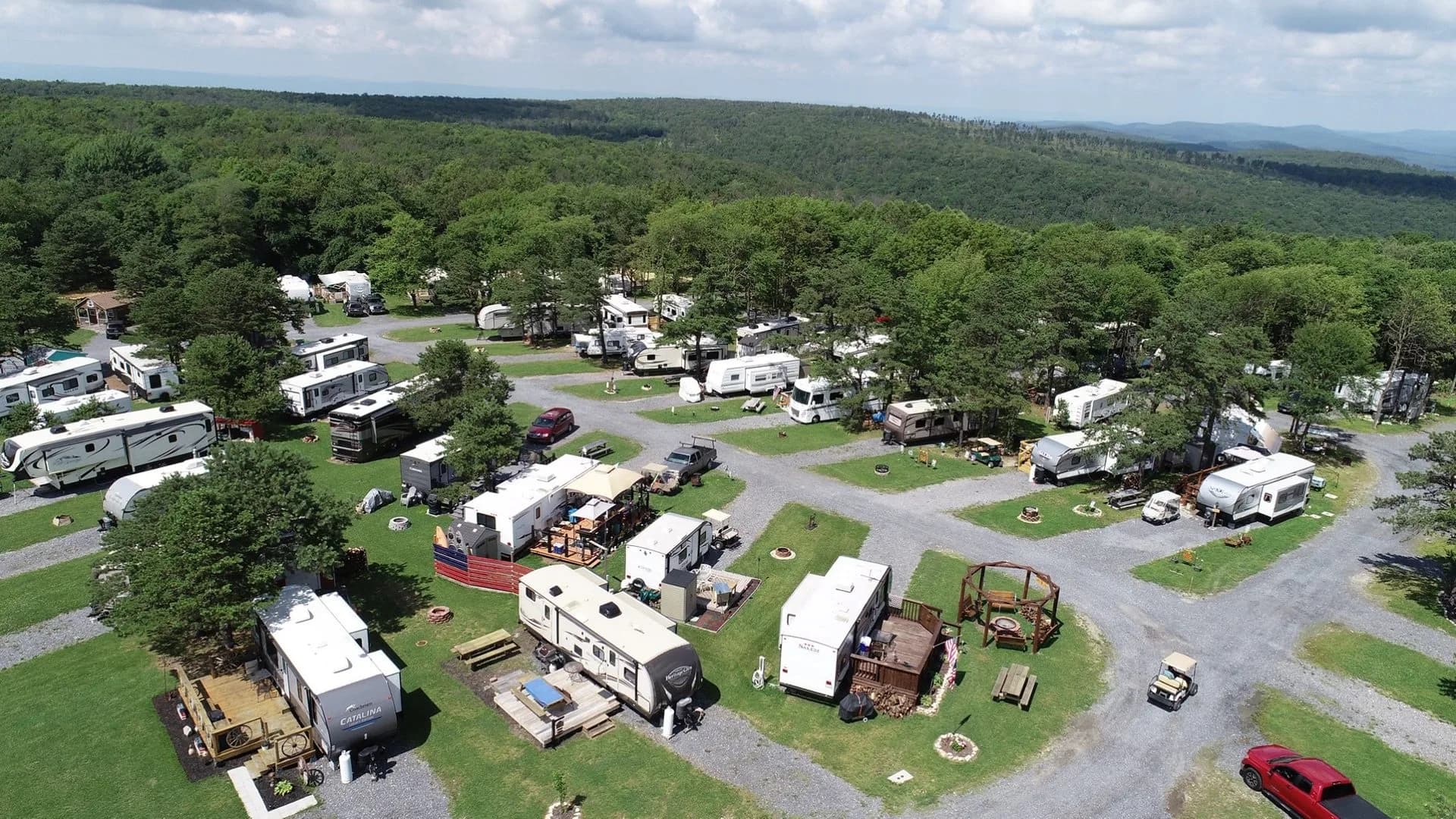
Pine Ridge Campground offers seasonal RV sites nestled in the beautiful Michaux State Forest, just 30 minutes from Gettysburg.